
Emergency Air Duct Cleaning Near Me: What Pompano Beach Homeowners Should Do First
Most calls we get about “emergency” duct cleaning in Pompano Beach aren’t really duct emergencies. They’re air quality scares – a sudden musty smell, debris at the registers, or standing water in the house after a storm. The right first move in almost every case is to identify what’s actually happening before anyone touches the ductwork, because a cleaning appointment booked too early can spread contamination instead of removing it. Below is the sequence we walk homeowners through, in order, with the specific steps that protect your options.
If you’d rather not sort through it alone, call (844) 795-4871 and we’ll help you figure out which scenario you’re in.
Key Takeaways
- Only three situations count as a genuine duct emergency: confirmed mold growth inside the ducts, active vermin intrusion, and smoke or fire residue.
- In a flood, the air handler matters more than the ducts. Don’t run the system until it’s been checked.
- Running your HVAC with a “better” filter after a flood spreads contamination. It doesn’t fix anything.
- Post-flood and post-storm duct work needs a mold assessment first, cleaning second.
- Ask any contractor under time pressure which equipment they’re bringing. A shop vac is the tell.
What Counts as a Real Duct Emergency in Pompano Beach?
Three situations are genuine duct emergencies: confirmed mold growth inside the ductwork, active vermin intrusion, and smoke or fire residue from a house fire or a nearby fire that pulled smoke into the system. Those three justify moving fast. Everything else, including strong smells and visible dust at the vents, is urgent-but-not-emergency, and you have time to do it correctly. Knowing which one you’re facing changes what you do in the first hour.
Here’s how the categories break down in a Pompano Beach home:
- Confirmed mold growth inside ducts. Confirmed means visible growth on duct interior surfaces or a mold assessment that identified it. A musty smell alone isn’t confirmation – it’s a reason to investigate.
- Active vermin intrusion. Rodents, insects, or birds nesting in the duct system. This one warrants prompt attention because contamination spreads every time the system runs.
- Smoke or fire residue. Fine soot particles pulled into the return side after a fire can settle throughout the ductwork and get re-circulated. This requires professional remediation, not a quick pass.
- Urgent but not emergency. A musty smell with no confirmed source, visible dust blowing from a register, or a recent renovation that filled the returns with drywall dust. These need scheduling, not panic.
What most homeowners don’t realize is that the urgency should follow the source of the problem, not the symptom. A smell from the ducts points to something in the ducts. A smell from a wet air handler points to the air handler. Those are different jobs, and cleaning the ducts first wastes money if the real problem is standing water in the mechanical closet.
What Should You Do First After Flooding Affects Your HVAC in Pompano Beach?
In the first two hours after a flood that affected your HVAC, the most important action is simple: don’t run the air handler. An air handler sitting in standing water is where active mold colonization starts, and running the system pushes that contamination through every duct in the house. That’s the point that saves you the most money and the most exposure – stop the system, then deal with the water.
Here’s the sequence that preserves your options:
- Turn the system off at the thermostat. Then turn it off at the breaker if you can safely reach it. Don’t run it “just to dry things out.”
- Photograph everything before you move it. Standing water line, wet insulation, water inside the air handler cabinet, wet duct connections. Your insurer will want it, and so will any assessor.
- Stop the water source if you can. If the source is a storm drain backup, call the city. If it’s a burst supply line, shut the valve.
- Remove standing water from the mechanical space with a wet/dry vac if it’s safe to do so. Do not climb into standing water near electrical equipment.
- Call a mold assessor and your HVAC tech in that order. Not a duct cleaner. The assessor establishes what’s growing and where, and the HVAC tech confirms the mechanical equipment is safe to run again.
If you’ve already run the system and you’re worried about what’s now in the ducts, don’t panic – the ducts can be cleaned once the source is fixed. But as a rule of thumb, we’re firm: don’t run the air handler in standing water. Mold needs moisture and time, and the air handler supplies both. Cutting the system off early is the cheapest mold remediation you’ll ever do.
In our experience, the homeowners who call a duct cleaner within 48 hours of a flood often spend more than the ones who called an assessor first and cleaned later. Duct cleaning before the source is addressed just puts clean ductwork back against a wet, contaminated air handler.
How Do You Reduce Air Quality Exposure While You Wait for Help?
While you’re waiting for a professional, there are measures that help and measures that backfire. Open windows when the outdoor air is reasonable, keep the system off, and use a box fan to move air out of the affected rooms. The single biggest mistake is buying a high-MERV filter and running the system – that pushes more contaminated air through the ductwork and loads the filter without containing anything.
What actually works in a Pompano Beach home:
- Ventilate. If the outdoor air is decent, windows open and fans pushing air out of the wettest room. In the humid months, use the AC’s fan-only mode only if the air handler has been cleared – otherwise leave it off.
- Contain the area. Close doors between the wet space and the rest of the house. Plastic sheeting over the doorway helps more than you’d think.
- Run a dehumidifier, not the AC. A portable dehumidifier in the affected space pulls moisture out without pushing air through ductwork.
- Wear an N95 mask if you’re moving wet materials or seeing visible growth.
- Don’t run fans across the wet area. A box fan blowing over a wet ceiling or wall spreads mold spores. Blow air out of the room instead.
The high-MERV filter backfire is worth explaining because it sounds logical and it’s wrong. A denser filter catches more particles per pass, yes – but only if the air is flowing through the system safely. If the air handler is wet or contaminated, that filter just gets colonized too. A filter is protection for a functioning system. It’s not a fix for a broken one. Swapping the filter and hoping is one of the most common mistakes we hear.
What Should You Ask When You Call a Duct Contractor Under Pressure?
Ask three things: what equipment they’re bringing, whether they’ll coordinate with a mold assessor, and whether their price is a fixed per-system quote or a per-vent number. Those three questions separate a qualified responder from someone with a shop vac and a coupon. Callers in a hurry often skip the questions and pay for it. Ask anyway, and don’t let a rushed schedule skip the biggest tell: the equipment.
Here’s what to listen for:
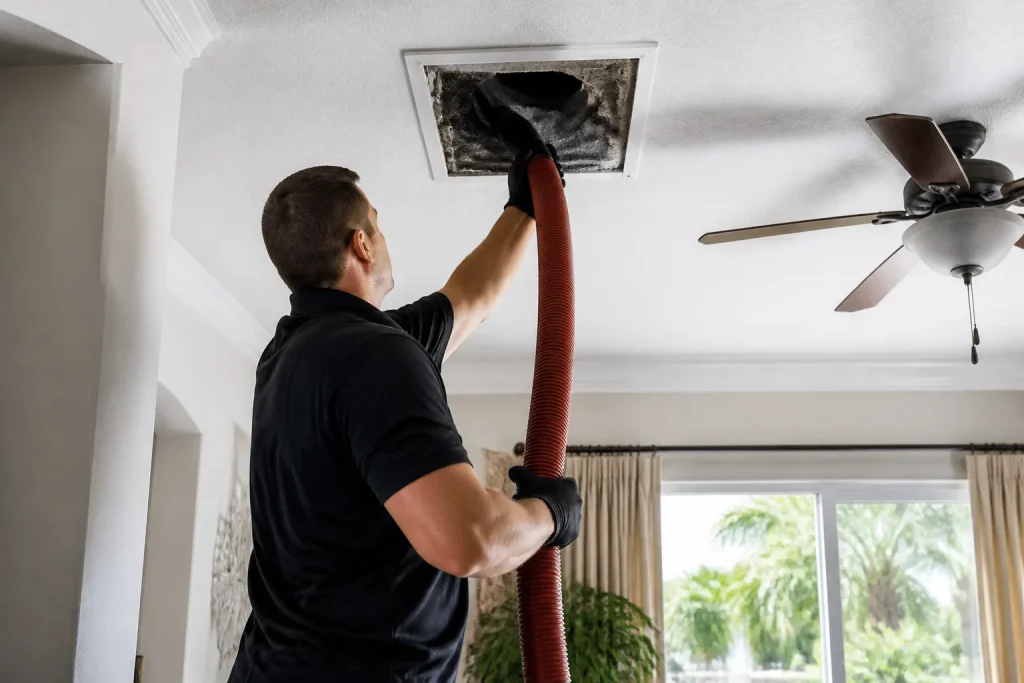
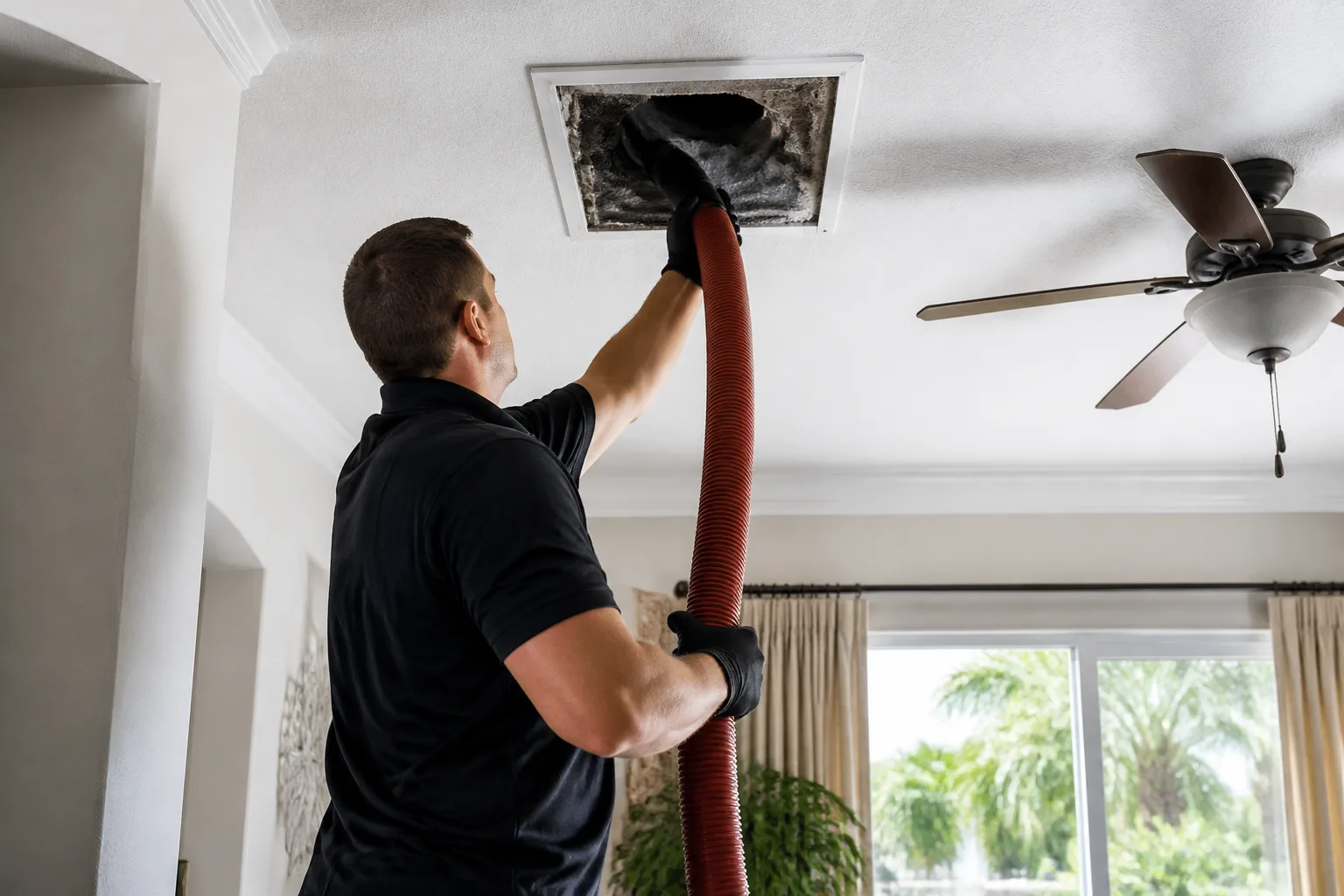
- Equipment. Ask them to name it. A duct cleaning crew that arrives with a rotary brush system like Rotobrush and negative-air equipment like Nikro is doing the work correctly. A crew that shows up with a consumer-grade vacuum and a hose is not containing anything – they’re just moving dirt around your house.
- Mold coordination. Ask whether they’ll wait for a mold assessor’s report before cleaning, or clean immediately regardless. A qualified responder will sync with the assessment. Someone who wants to clean before the assessor walks the house is telling you something.
- Pricing structure. Ask if they price per system or per vent. Per-vent pricing is how a small job becomes a big one, because every vent becomes an upcharge. A per-system quote is the only one you can compare honestly.
- Proof of work. Ask whether they provide before-and-after photos of your ducts. A crew that photographs its own work has a different relationship to accountability than one that doesn’t.
One more subtle tell: ask what they do about containment. A crew using negative-air and filtration equipment thinks in containment terms – the same discipline used in professional remediation. If containment isn’t in the answer, it isn’t in the job.
Why Post-Storm Duct Cleaning in Pompano Beach Should Follow Mold Assessment
Post-storm and post-flood duct cleaning in Pompano Beach should follow a mold assessment, not precede it. The reason is simple: duct cleaning removes what’s there, but it can’t identify whether the source of the problem is still active. A mold assessor establishes what’s growing, where, and whether the building materials are still wet. Cleaning before assessment can hide the problem without fixing the cause – and in humid Florida conditions, an unidentified moisture source will recolonize the ducts once the system runs again.
The correct sequence in a Pompano Beach home after a storm:
- Stop the system. No air handler running until it’s been checked.
- Document the damage. Photos, water lines, date, time.
- Call your insurer. Get the process started.
- Schedule a mold assessment. The assessor writes a report identifying the contamination and the moisture source.
- Fix the moisture source. The leak, the standing water, the wet insulation – the source has to go before the ducts can stay clean.
- Then clean the ducts. After the source is remediated and the air handler is dry and safe to run.
We’ve seen homes in Pompano Beach where the ducts were cleaned first and recontaminated in a few weeks, because the moisture source – a slowly leaking condensate line, a soaked ceiling cavity, a wet wall behind a cabinet – was never addressed. Cleaning is the last step. The earlier steps are what make the cleaning stick.
The link between the two services matters too: an air duct repair is sometimes the fix, because a section of ductwork damaged by water is a source of the problem regardless of how many times it’s cleaned. Dirty ducts and damaged ducts aren’t the same problem, and a company that only cleans will keep cleaning the same section instead of repairing it.
When to Call a Pro
Call a professional when you have confirmed mold inside the ducts, active vermin, smoke residue, or a flooded HVAC system. Call before you run the system. Call before you buy any filter. And call with the three questions above ready, because a rushed call without questions is how people end up paying twice. We answer 24/7, with fast dispatch from 7am to 7pm, Sunday through Friday. A call outside those dispatch hours is booked into the next opening, Sunday through Friday, 7am to 7pm.
One small joke that’s actually not a joke: if a contractor’s equipment fits in the trunk of a sedan, it isn’t equipment – it’s a suggestion.
Related services in Pompano Beach: For standard scheduled cleaning, see air duct cleaning. If your dryer is taking long to cycle, dryer vent cleaning is the service that directly reduces fire risk. For structural issues, we handle air duct repair as a standalone service. And to learn more about the company, visit Valor Air Duct Cleaning. If you’re looking for a broader overview of what we do in Pompano Beach, start there.
The Bottom Line
Most “duct emergencies” in Pompano Beach have a first step that isn’t a cleaning appointment. Stop the system in a flood. Verify mold before you clean. Coordinate with an assessor, not around one. Ask three questions before you book. Do those things and you’ll save money, avoid spreading contamination, and end up with clean ducts that stay clean – which is the entire point of the work.
If you’re in Pompano Beach and need help sorting out a real duct problem, Valor Air Duct Cleaning offers free estimates. Call (844) 795-4871. We answer 24/7, with fast dispatch from 7am to 7pm, Sunday through Friday. Ask us what equipment we’re bringing. We’ll tell you by name, because professional-grade equipment isn’t the same as a shop vac with a logo on it.
Frequently Asked Questions
We price per system, not per vent, and the written estimate sets the final number. We don’t publish a flat emergency rate because the scope depends on what’s actually wrong – a standard whole-system cleaning is very different from post-flood work that needs containment and coordination with an assessor. Call (844) 795-4871 for a free, specific quote. The estimate is free, and the price is set per job by the written estimate before any work starts.
No. A higher-MERV filter on a system whose air handler is wet or contaminated doesn’t fix anything – it spreads contamination through the ductwork and loads the filter with material it can’t safely trap. Stop the system, address the water source, get the air handler checked, and only then think about filter upgrades. If the air handler is dry and verified safe, filter choice is a normal maintenance decision.
Ask for before-and-after photos of your own ducts, not stock photos. Ask which equipment was used and confirm it’s rotary brush and negative-air, not a shop vac. If the crew can name their equipment (Rotobrush, Nikro, Abatement Technologies are the professional-grade names) and show you its work, you have your answer. If they can’t, you don’t. Call us at (844) 795-4871 and we’ll walk through exactly what a job involves before we start.
There’s no single right interval – it depends on the house, the household, and events like renovations, pets, and water damage. A general rule is to schedule when you have a reason: a renovation that filled the returns, a new HVAC install, a water event, visible debris at the registers, or allergy concerns that started recently. After a flood, the sequence is assessment, source fix, then cleaning – not a fixed annual schedule. If you’re unsure whether it’s time, call (844) 795-4871 for a free estimate and an honest read.
Written by the team at Valor Air Duct Cleaning, serving Pompano Beach since 2018.
Need Air Duct Cleaning Help?
Call Valor Air Duct Cleaning - licensed & insured, with free written estimates in Pompano Beach.
(844) 795-4871